
Lessons from Wesley Pydiamah on Career, Practice, and AI in International Arbitration
THE AUTHOR:
Tiffany Lam, Communications Officer at Jus Mundi
As part of our ongoing series, we connect with leading professionals and exceptional thinkers to share insights on practice, trends, and the evolving role of technology. Each session highlights real-world takeaways, offering a window into the challenges and innovations shaping today’s professional landscape.
Building great legal technology requires more than engineering expertise. It demands deep understanding of the practitioners who rely on it. That is why at Jus Mundi, we regularly invite leading arbitration professionals to share their insights with our team.
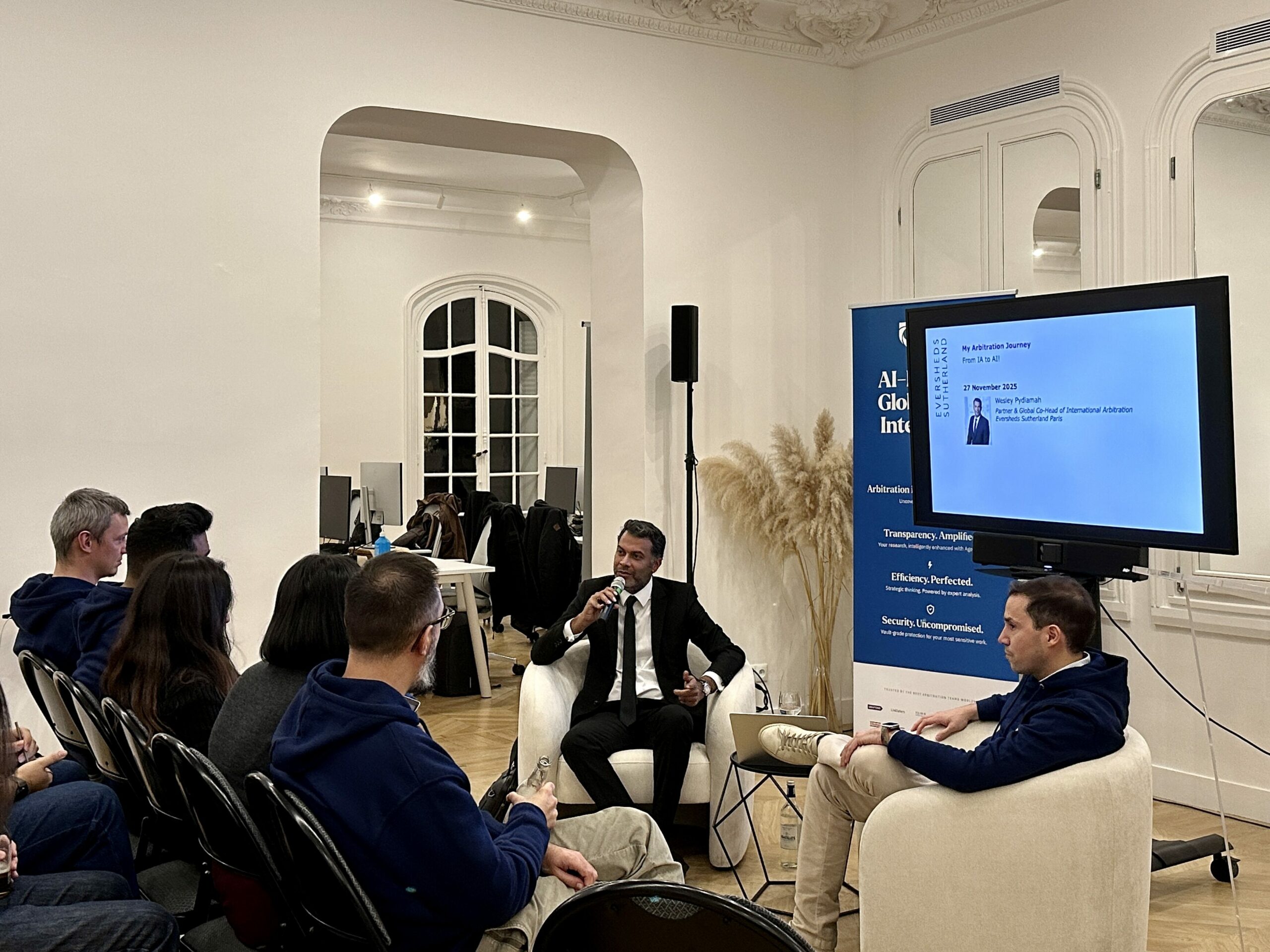
On 27 November 2025, we had the pleasure of hosting Wesley Pydiamah, Partner and Global Co-Head of International Arbitration at Eversheds Sutherland, in our Paris office. Wesley leads a practice that spans complex commercial and investment treaty disputes across multiple jurisdictions. His career offers valuable lessons for anyone interested in complex arbitration, from the skills required to navigate intricate cross-border disputes to the strategic thinking that defines successful arbitration practice. Beyond casework, Wesley represents the practitioner perspective that shapes how we think about arbitration intelligence at Jus Mundi. Understanding how counsel approach research, build
Inside the Session: Bridging Practice and Technology
The session covered ground that rarely gets explored in traditional arbitration conferences. Wesley shared candid reflections on his career journey, offering insights into the evolving expectations of legal practice.
He also delved into his rich experience in specific sectors such as energy and telecoms, as well as public international law matters, including proceedings before the Iran-US Claims Tribunal in The Hague. These concrete examples helped our team understand how arbitration lawyers think and work, the challenges they encounter, and the pressure points where technology can create meaningful impact.
Just as valuable was Wesley’s perspective on how his team integrates Jus Mundi in their practice. For his global group, the platform serves as a central resource for legal research, offering fast access to awards, pleadings, doctrine, and arbitrator profiles, all in one place. The breadth of our data plays a critical role in arbitrator conflict checks and day-to-day case preparation. His observations offered a grounded view of how the tool is applied in practice and where further development could be valuable.
AI Meets Arbitration: Insights from the Field
The conversation naturally turned to the role of Artificial Intelligence (“AI”) in arbitration, a topic increasingly relevant across global practice.
Wesley shared a balanced view informed by how his teams are experimenting with AI solutions. He noted that AI already delivers efficiency gains in research and document review, speeding up the identification of relevant cases and supporting first-draft outlines. AI also shows potential in case management, from organising documents and timelines to assisting with procedural tasks. At the same time, he emphasised cautious integration, highlighting the importance of maintaining junior-lawyer training, protecting confidentiality, and ensuring accuracy, with lawyers remaining fully responsible for analysis and strategic decisions.
Crucially, this practitioner perspective reinforces the importance of developing AI thoughtfully and collaboratively, ensuring it enhances the work of arbitration teams rather than replacing the human expertise at the centre of the process.
Why These Conversations Matter
Conversations like this help deepen the exchange between practitioners and the people building the tools they rely on. Wesley’s guest talk reflects Jus Mundi’s commitment to the arbitration community. We are not developing tools in isolation; we are building with the practitioners and institutions who use them daily. This ensures our work responds to real challenges rather than abstract assumptions, contributing to our mission of making arbitration intelligence more accessible and useful for all.
We are grateful to Wesley Pydiamah for sharing his time and insights with our team. As we continue this series, we look forward to further dialogues that help strengthen the bridge between arbitration practice and legal technology, an essential space for meaningful and collaborative innovation.
Are you a practitioner, innovator, or thought leader with perspectives on technology and professional practice? We would love to hear from you. Connect with us on LinkedIn or reach out via [email protected] to continue the conversation.
About Jus Mundi
Founded in 2019 and recognized as a mission-led company, Jus Mundi is a pioneer in the legal technology industry dedicated to powering global justice through artificial intelligence. Headquartered in Paris, with additional offices in New York, London, and Singapore. Jus Mundi serves over 150,000 users from law firms, multinational corporations, governmental bodies, and academic institutions in more than 80 countries. Through its proprietary AI technology, Jus Mundi provides global legal intelligence, data-driven arbitration professional selection, and business development services.

*The views and opinions expressed by authors are theirs and do not necessarily reflect those of their organizations, employers, or Daily Jus, Jus Mundi, or Jus Connect.