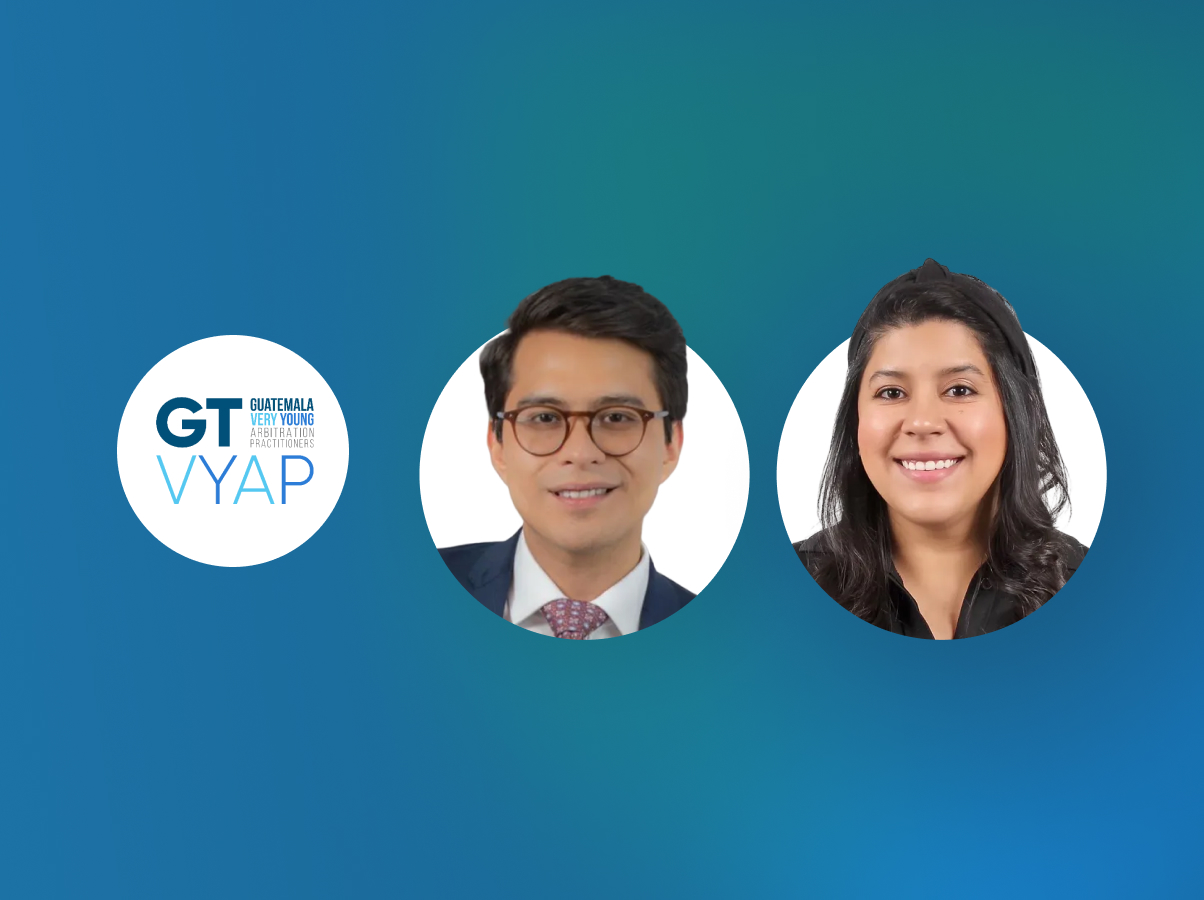
This article was featured in Jus Mundi‘s 2025 Arbitration Year in Review, an annual publication analyzing arbitration developments across 40+ jurisdictions on 6 continents. This edition brings together young practitioners and senior experts to capture the year’s most significant legislative reforms, enforcement trends, and institutional innovations.
THE AUTHORS:
David Enriquez, International Arbitration Member, ECIJA
Sofía Galindo, Associate, Adell & Merizalde
This year was particularly relevant for arbitration in Guatemala. Two investment arbitration cases were filed; local courts issued key decisions which have impacted the local framework for commercial and investment arbitrations; sectors prone to arbitration disputes had major developments; and local arbitral institutions contributed to the improvement of the arbitral landscape in the country.
Investment Treaty Case Development
Within the context of investor-State dispute resolution, three major cases saw developments in 2025: Energía y Renovación Holding, S.A. v. Republic of Guatemala, ICSID Case No. ARB/21/56 (“Energía y Renovación”), Grupo Energía Bogotá S.A. E.S.P. & Transportadora de Energía de Centroamérica S.A. v. Republic of Guatemala (I), ICSID Case No. ARB/20/4. (“GEB & TRECSA”) and Daniel W. Kappes and Kappes, Cassiday & Associates v. Republic of Guatemala, ICSID Case No. ARB/18/43. (“Daniel W. Kappes”). In Energía y Renovación, the Tribunal issued a final award holding Guatemala internationally responsible for breaching the 2002 Central America-Panama Free Trade Agreement (FTA). In GEB & TRECSA, a decision on jurisdiction was issued, and hearings on jurisdiction, merits and quantum were held. Finally, in Daniel W. Kappes the Tribunal issued an award, dismissing all claims and upholding that Guatemala did not breach the 2002 Central America-Panama Free Trade Agreement (“CAFTA”).
Energía y Renovación Holding, S.A. v. Republic of Guatemala, ICSID Case No. ARB/21/56
The dispute in Energía y Renovación Holding, S.A. v. Guatemala arose from alleged failures by the Guatemalan State to protect the investor’s hydroelectric projects, licenses, permits, and shares in its domestic subsidiaries. According to the claimant, Guatemala failed to answer adequately to repeated violent incidents by local indigenous communities, including attacks, threats, and damage to equipment, which caused delays and increased project costs. The investor initiated the arbitration under the CAFTA, claiming breaches to the full range of standards for protection for foreign investments.
Guatemala opposed the investor’s claims and challenged the tribunal’s jurisdiction on ratione materiae and personae grounds including by arguing that the investment was illegal because its domestic laws prohibit foreigners from owning real estate within the country’s borders.
The Tribunal issued an Award on March 31, 2025. The majority of the Tribunal rejected Guatemala’s jurisdictional challenges, considering them to be circular. On the merits, the Majority held Guatemala liable for failing to protect the investor’s hydroelectric projects from persistent social unrest and community hostility, awarding approximately US $64.5 million in damages and costs. The Tribunal found that Guatemala’s failure to exercise vigilance and due diligence constituted a breach to the CAFTA.
Prof. Raul E. Vinuesa issued a dissenting opinion, where he expressed his disagreement on the legality of the investment, the statute of limitations, and the quantum of damages.
October 24, 2025, Guatemala filed an application for annulment under Article 52 of the Convention on the Settlement of Investment Disputes between States and Nationals of Other States (1965) (“ICSID Convention”). The annulment proceedings are currently ongoing.
Grupo Energía Bogotá S.A. E.S.P. & Transportadora de Energía de Centroamérica S.A. v. Republic of Guatemala (I), ICSID Case No. ARB/20/48
GEB & TRECSA initiated ICSID proceedings against Guatemala under the Colombia–Guatemala–El Salvador–Honduras Free Trade Agreement (2007), claiming that Guatemala violated treaty protections in relation to a large electricity-transmission project. The dispute centers on the alleged failure by Guatemala to comply with its contractual obligations, particularly with respect to force majeure provisions and the delayed issuance of authorizations for the project’s construction. These setbacks, according to the claimants, caused substantial delays and additional costs.
Guatemala raised four preliminary objections, arguing that claims were time-barred, that parallel proceedings are ongoing before Guatemalan domestic courts, and that the challenged measures did not constitute treaty breaches. In a November 24, 2023, decision, the tribunal rejected most of the jurisdictional objections, but upheld Guatemala’s objection to investor’s use of several umbrella-clauses from other treaties via the FTA’s Most Favoured Nation (“MFN”) clause, ruling it lacked jurisdiction over those.
In 2025, from July 07 to July 12, a hearing on jurisdiction, merits, and quantum took place..
Daniel W. Kappes and Kappes, Cassiday & Associates v. Republic of Guatemala, ICSID Case No. ARB/18/43.
Daniel Kappes initiated arbitration proceedings against Guatemala arguing the breach of the Minimum Standard of Treatment (“MST”) and protection against expropriation.
In 2025, the Tribunal issued a historic decision declining to award damages for suspension of the investor’s mining license pending community consultations under the the ILO Convention concerning Indigenous and Tribal Peoples in Independent Countries (“Convention No. 169”). This decision, uncommon in investment arbitration, granted Guatemala a clear victory.
Key Local Court Decisions Impacting International Arbitration
In 2025, Guatemalan courts issued two decisions relevant to the local arbitration framework. The first concerns a new law that introduced a provision regarding umbrella clauses. The second decision pertains to the application of the ICC Arbitration Rules and the waiver of the right to challenge an award through a domestic revisión proceeding – a particular feature of the Guatemalan arbitration framework.
Unconstitutionality of the Umbrella Clause in the Ley de Infraestructura Vial Prioritaria.
In November 2024, Guatemala’s Congress enacted the Ley de Infraestructura Vial Prioritaria or Priority Road Infrastructure Law (“LIVP”). The LIVP regulates the contracting of priority road projects, aiming to enhance legal certainty and security for investors. It establishes mechanisms to ensure project execution and timely payments, while promoting competition and international participation through measures such as using English in bidding documents and meetings, pre-qualifying international bidders, and removing obstacles to their participation.
One of the highlights of the LIVP was the inclusion of a so-called umbrella clause allowing foreign investors to resort to ICSID arbitration if a relevant investment treaty applies. According to Art. 84 of the LIVP: “Foreign investors will have the right to resort to ICSID provided that an Investment Treaty applicable to the investor so provides. For the purposes of Investment Arbitration, this article shall be understood as an umbrella clause for Road Infrastructure Contracts”. Umbrella clauses are commonly found in treaties but, it is rare to find them as part of domestic law as these benefits for foreign investors are often negotiated in an international context and subject to reciprocity.
On July 9, 2025, the Guatemala’s Constitutional Court ruled that Art. 84 was unconstitutional. The Constitutional Court considered that the umbrella clause in the LIVP was disproportionate as it grants unilateral privileges to foreign investors without reciprocity to Guatemalan investors, which creates both economical and legal uncertainty for Guatemala.
Guatemalan Constitutional Court Upholds Waiver to Challenge Award Under ICC Rules
Under Art. 43 of the Guatemala’s Arbitration Law, awards may be challenged before the Court of Appeals, which can order an award’s modification or annulment.
This may run contrary to international practice which considers awards to be final, binding, and enforceable under the law. However, recently the Court of Appeals confirmed that, in arbitrations administered by the ICC, the parties are deemed to have waived their right to challenge the award under Art. 35 of the ICC Arbitration Rules. This new interpretation aligns Guatemalan jurisprudence with international standards.
Recently, the Constitutional Court confirmed the view of the Court of Appeals and further elaborated on the application of the stoppel or non venirem contra factum propium principle to the waiver of the right to challenge an award. The Constitutional Court concluded that, if the conduct of a party to the arbitration agreement indicates that it effectively waived its right to challenge the award, then the revisión proceeding will not be considered available as a remedy against the award
Recent Developments in Sectors Prone to Arbitration Disputes
Mining
Back in 2024, International Metal Supply Holding S.A (a Swiss company, parent of Guatemalan mining company Mayaníquel) filed a Notice of Intent under the Switzerland-Guatemala Bilateral Investment Treaty (“BIT”) (2002), arguing that Guatemala unlawfully blocked its nickel-export operations by withholding the necessary export credentials and imposing unjustified administrative restrictions. The claim is estimated at around US $100 million.
Although this case has no significant updates for 2025, based on conversations with stakeholders in the mining sector, it appears that the dispute continues to deepen based on recent measures by the Guatemalan mining authorities.
Energy
In April 2025, Guatemala’s national electricity distributors and the CNEE launched PEG 5, the country’s largest energy tender, aiming to contract up to 1,400 MW for delivery between 2030 and 2045, with an estimated US $4 billion investment. PEG 5 removes the previous price cap and restricts participation from existing plants to encourage new developments. Compared to previous PEG tenders, the PEG 5 introduces several key innovations. It eliminates the previous cap on the maximum sale price to distribution companies––a cap previously tied to outcomes from previous PEGs––and limits participation from existing power plants to encourage the development of new plants.
Guatemala’s electricity sector is notoriously active in international commercial and investment arbitrations. With the launch of PEG 5 and the expected investment of billions of dollars, the risk of future disputes is heightened: new long-term contracts (PPAs) with both local and foreign investors, novel regulatory frameworks (e.g., for energy storage), and large-capacity generation projects all create fertile ground for potential contractual or treaty-based claims.
As Guatemala expands its grid and promotes competition, investors could challenge future regulatory decisions, changes in price or capacity terms, or enforcement of contractual obligations, making the sector a likely hotspot for arbitration.
Updates on Local Arbitration Centers in Guatemala
In 2025, Guatemala’s arbitration institutions saw a notable generational shift in leadership. At the Comisión de Resolución de Conflictos de la Cámara de Industria de Guatemala (“CRECIG”), Victor López was appointed General President and Coordinator, while Carolina Diab continues to contribute from the Board of Directors. Similarly, at the Arbitration and Conciliation Center of the Chamber of Commerce of Guatemala (“CENAC”), Edson López assumed the role of President, and Maria Eugenia Ferreyra was appointed General Director, signaling the emergence of a new generation of leaders shaping the future of arbitration in the country.
IBT Arbitration Center
The IBT Arbitration Center (“IBT”), established in 2021, has quickly become a leading Guatemalan arbitral institution specializing in technology, financing, and consumer protection. In just four years, IBT has consolidated its position as a reference for promoting effective alternative dispute resolution methods. In 2025, the Center handled over 40 cases—the highest caseload in the Northern Triangle (Guatemala, El Salvador, and Honduras)—with a majority focused on the financing sector.
Discover more insights into the latest developments in arbitration in 2025 from around the world now
ABOUT THE AUTHORS
David Enriquez is part of the Dispute Resolution department at ECIJA Guatemala, where he focuses on international arbitration. He has provided support in complex cases involving multi-party arbitrations and in a wide range of industries, such as pharmaceuticals, financing, construction and investments, and has previous experience in public international law. He is an alumni of DLA Piper’s Global Scholarships Programme and a founding member of Club de Derecho y Negocios Internacionales, a local organization that seeks to bolster the attractiveness of Guatemala for international commerce and as a seat for international arbitration.
Sofía Galindo is an associate at Adell & Merizalde, based in Bogotá, Colombia, focusing on international arbitration disputes, including both commercial and investment-treaty matters, with a particular emphasis on Latin American parties. She has experience acting under major arbitration frameworks, including the International Centre for Settlement of Investment Disputes (“ICSID”), the United Nations Commission on International Trade Law (“UNCITRAL”), the International Chamber of Commerce (“ICC”), and the Permanent Court of Arbitration (“PCA”), gained through her work in the international arbitration teams of top-tier law firms in Paris, London and Bogotá. Sofía holds a law degree from Universidad Francisco Marroquín in Guatemala and an LL.M. from Queen Mary University of London. Sofía is a founding member of the Guatemalan Very Young Arbitration Practitioners (“GTVYAP”), part of the Global VYAP Network.
*The views and opinions expressed by authors are theirs and do not necessarily reflect those of their organizations, employers, or Daily Jus, Jus Mundi, or Jus Connect.