
THE AUTHORS:
Volodymyr Nakonechnyi, Managing Associate at Arzinger Law Firm
Anastasiia Kotliarchuk, Senior Associate at Arzinger Law Firm
Mariia Vakarieva, Paralegal at Arzinger Law Firm
This article was featured in Jus Mundi‘s 2025 Arbitration Year in Review, an annual publication analyzing arbitration developments across 40+ jurisdictions on 6 continents. This edition brings together young practitioners and senior experts to capture the year’s most significant legislative reforms, enforcement trends, and institutional innovations.
For almost four years, Ukraine has been perceived and discussed through the lenses of war, martial law, and future reconstruction. One may even argue that the country has undergone a profound transformation in nearly every public sphere. Yet, when it comes to international arbitration, the expected shift simply did not happen. The context surrounding arbitration indeed has changed, but the system remains stable and functioning. The courts continue to enforce awards, institutions have operated without major interruption since April 2022, and no drastic legislative shifts have disrupted the existing framework.
What did emerge, however, is an entirely new category of disputes driven by the wartime sanctions legislation – the number of such disputes against Ukraine continues to grow (Section II.A.). In parallel, Ukrainian investors continue pursuing compensation from Russia for loss of their assets, both through enforcement efforts in the long-running Crimean cases and through a new series of claims initiated after the 2022 full-scale invasion (Section II.C.). Commercial disputes in the defence sector become increasingly common due to the expansion of Ukraine’s military industry (Section III). Legislative and institutional reforms keep contributing to the favourable arbitration landscape in Ukraine (Section IV).
Investment Arbitration
Sanctions-Related Cases against Ukraine
Ukraine’s sanctions regime, introduced in response to Russia’s armed aggression, allows seizure and nationalization of assets through court proceedings initiated by the Ministry of Justice of Ukraine. Investors, deprived of their property without compensation – most often due to their Russian ties – resort to investor-state claims, seeking any possible recovery.
- In May 2025, the tribunal in ABH Holdings S.A. (“ABH“) v. Ukraine (ICSID Case No. ARB/24/1) granted Ukraine’s bifurcation request, separating the liability and quantum phases. ABH, controlled by Russian businessmen Mikhail Fridman and Petr Aven, claims compensation for allegedly unlawful, discriminatory, and accompanied by a “black PR campaign” nationalisation of Sense Bank. The parties are now actively exchanging their submissions, with the next round scheduled for 23 February 2026. As a part of a broader strategy, Fridman and Aven also challenged the EU sanctions before the Court of Justice of the European Union (“CJEU”). On 10 April 2024, the CJEU annulled the initial listing decision dated 28 February 2022 due to insufficient reasoning. The subsequent listing decisions remained in force despite similar challenges. Another branch of this strategy is Fridman launching the first known treaty arbitration against Luxembourg.
- Cases Enwell Energy plc v. Ukraine (ICSID Case No. ARB/25/41) and Smart Energy B.V. and PJSC Ukrgazvydobutok v. Ukraine (ICSID Case No. ARB/25/38) were filed by companies under the control of the pro-Russian businessman Vadym Novynskyi. The claims concern wartime regulatory measures, including sanctions and state intervention in the management of energy assets. The claimants adopted an aggressive stance, requesting provisional measures at the outset of proceedings. The tribunal’s appointment has reached its concluding stage as of December 2025.
- AEROC v. Ukraine: Ukraine faced an ICSID claim over sanctions-based expropriation measures, filed by AEROC Investment Deutschland GmbH (“AEROC“), a German company ultimately controlled by the Russian businessman Andrey Molchanov. The tribunal was constituted in early November 2025. In parallel, AEROC challenged the sanctions regime before the Constitutional Court of Ukraine, arguing that the measures breached principles of legal certainty, equality and right to property. Hearings commenced late last year.
- Optim Holding v. Ukraine: Optim Holding, a Vienna-based company founded by Ukrainian citizen Oleg Zudov, filed an ICSID claim after the Ukrainian authorities sanctioned the company in 2023. The claim concerns alleged “effective expropriation”.
- Ferrexpo v. Ukraine: In March 2025, a London-based iron ore producer, Ferrexpo plc, and its Swiss subsidiary, Ferrexpo AG, notified Ukraine of an investment claim. The notice followed the seizure of the company’s Ukrainian assets amid criminal proceedings against its founder Kostyantyn Zhevago, sanctioned in February 2025. The dispute concerns the nationalization of nearly half of the corporate rights in Ferrexpo Poltava Mining and their transfer to a state agency. Ferrexpo insists the measures are politically driven, legally unfounded, and unrelated to Zhevago’s alleged embezzlement case.
- Tatneft v. Ukraine (II): Tatneft, a Russian oil company, filed a Notice of Dispute against Ukraine, alleging unlawful and discriminatory confiscation of its assets. This is the second case brought by this claimant against Ukraine: in Tatneft v. Ukraine (PCA Case No. 2008-8), the company was awarded USD 112 million for the loss of shares in the Kremenchuk refinery, but the arbitral award remains unenforced.
As Ukraine continues expanding wartime regulatory measures, further investment claims are likely to emerge. In this context, the Ministry of Justice remains a key agency involved both in the confiscation of sanctioned assets and Ukraine’s defence in investor-state disputes.
Other Investor-State Cases against Ukraine
- Like Spain and Italy, Ukraine cut its previously generous “green tariff” for renewable energy producers in 2020. This decision generated significant tensions with investors in the renewable energy sector, giving rise to several investor-state disputes. In 2025, Modus Energy International B.V. v. Ukraine remained the only renewable energy arbitration case progressing. Modus Energy International launched three solar power plants in 2019 under a tariff guaranteed until 2029. After the 15% reduction, the claimant alleged that Ukraine had undermined its legitimate expectations and breached fair and equitable treatment standard under the Energy Charter Treaty (1994). The merits hearing took place in April 2025. In January 2026, the Ministry of Justice of Ukraine, reported a win in this case. According to the press-release the SCC tribunal decided that Ukraine properly exercised its right to regulate for public purpose and positively assessed Ukraine’s efforts to negotiate the change of the green tariff with the industry.
- The long-running case of Gilward Investments B.V. v. Ukraine (ICSID Case No. ARB/15/17) concluded in 2025. The case concerned a USD 947 million claim arising from the collapse of Aerosvit Airlines (Ukraine’s largest commercial airlines before 2013). The claimant alleged that Ukraine restricted its access to international routes, granted preferential conditions to competitors, expropriated land plots, delayed VAT refunds and interfered with Aerosvit’s bankruptcy proceedings. In August 2025, the tribunal discontinued the case after the claimant failed to pay advances on costs, effectively closing the proceedings in Ukraine’s favour.
Ukrainian Claimants
In 2025, Ukrainian claimants continued pursuing their claims against Russia, however, with various intensity. New claimants make initial steps carefully, assessing the evolving legal landscape, in particular, the International Compensation Mechanism for Ukraine:
- Oschadbank v. Russia (II): On 24 July 2025, Oschadbank sent a formal Notice of Dispute to Russia seeking compensation for the loss of investments in the occupied Donetsk, Luhansk, Kherson, and Zaporizhzhia Regions.
- Ukrhydroenergo v. Russia: After sending a Notice of Dispute against Russia for the destruction of the Kakhovka Hydroelectric Power Station in mid-2024, Ukrhydroenergo did not take any procedural steps in 2025 – the company cancelled its tender for legal services in the planned investor-state dispute to align its legal strategy with Ukraine’s broader national policy on reparations.
- An investment dispute by confidential Ukrainian investors for losses in Donbas since 2014 commenced in the summer of 2024 and remains at the cooling-off stage in 2025.
- Rinat Akhmetov v. Russian Federation, PCA Case No. 2025-02 and Energoatom v. Russia remain slow-moving.
Award holders actively target Russian assets in various jurisdictions in enforcement proceedings:
- In 2025, Naftogaz Group made notable progress in enforcing its USD 5 billion award (Naftogaz and others v. Russia, PCA Case No. 2017-16):
- An Austrian court authorised the attachment of more than 20 Russia-owned real estate properties;A French court granted exequatur;
- A Finnish court granted interim measures (attachment of movable and immovable property for tens of millions of USD). Russia attempted to challenge interim measures in Finland. In its appeal, it relied on sovereign immunity arguments and the special protection of diplomatic property. Yet, the Helsinki Court of Appeal rejected such arguments and confirmed that interim measures were lawful and proportionate to safeguard Naftogaz’s rights.
- Oschadbank’s Crimea-related case reached a decisive stage. After French Cassation Court annulled Oschadbank’s USD 1.5 billion award in 2022 and remanded the case for new consideration, in July 2025 the Paris Court of Appeal issued a new judgment dismissing all Russia’s objections and upholding the PCA award. This judgment opens the way for Oschadbank to continue enforcement in the United States and take steps in other jurisdictions.
- In November 2025 a Dutch court upheld the provisional attachment of assets of a gas pipeline operator South Stream Transport owned by Russia’s Gazprom in support of DTEK Krymenergo’s enforcement of USD 300 million award.
Commercial Arbitration: Defence Industry on the Rise
Commercial arbitration is a common dispute resolution mechanism across key economic sectors in Ukraine. The defence industry is not an exception: rapid wartime expansion has led to a noticeable increase in defence-related disputes.
Defence companies tend to refer their cases to arbitration. As confirmed by the Vice President of International Commercial Arbitration Court at the Ukrainian Chamber of Commerce and Industry (“ICAC“), Mr. Volodymyr Nahnybida, defence-related disputes constitute a notable share of the ICAC’s 2025 caseload, accounting for around 10% of new filings (26 cases) and 11% of сonsidered cases (30 cases).
Moreover, Ukraine-related defence disputes are resolved under the premises of prominent arbitral institutions around the world. Some recent publicly reported cases include:
- Ukraine’s Spetstechnoexport launched LCIA arbitration against Virginia-based Regulus Global seeking to recover USD 347 million in advance payments and penalties under a 2022 contract for the supply of artillery shells;
- An Arizona court enforced a VIAC award requiring OTL Firearms and Imports Corporation, a US weapons exporter to pay USD 20 million to Progress, a Ukrainian state-owned arms trading company over undelivered ammunition supplies.
Ukraine also adjusted its enforcement framework to wartime realities – according to the Amendments to the Law on Enforcement Proceedings, enforcement proceedings against Ukrainian defence companies are now paused for the duration of martial law in Ukraine.
Ukraine as Arbitration-Friendly Jurisdiction: ICAC Reform and Changes to Legislation
Ukrainian lawmakers and ICAC are modernizing the country’s arbitration framework to strengthen Ukraine’s reputation as an arbitration-friendly jurisdiction.
Ukrainian Parliament works on Bill No. 12141 (“Bill“). Its updated version is now recommended for a second and final reading. The Bill seeks to extend the jurisdiction of Ukrainian arbitration institution in line with the UNCITRAL Model Law on International Commercial Arbitration (2006) and promote Ukraine as a seat for the resolution of investor-state disputes.
ICAC continues to demonstrate institutional resilience throughout martial law. In 2024, ICAC registered a higher number of cases than many major arbitral institutions, recording 453 new cases and significantly surpassing SCC (204 cases), DIS(158 cases), VIAC (45 cases), and LCIA (356 cases) in 2024. ICC remained the global leader with 841 cases.
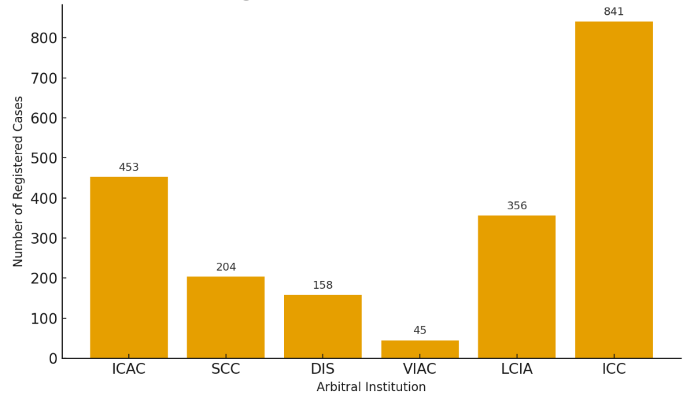
By mid-November 2025, ICAC registered 269 new cases and resolved 275 cases. This represents a substantial caseload despite the constraints and disruption caused by the war.
As a part of its digital transformation agenda, ICAC is now upgrading digital tools by developing a comprehensive online dispute-resolution platform. It is expected to be launched in 2026. The platform shall make case management faster and more convenient, in line with best practices of leading arbitration institutions.
Trends and Predictions
We expect that:
- The number of sanctions-related investment disputes against Ukraine by Russian and pro-Russian businesses is likely to grow.
- A large wave of new claims by Ukrainian investors against Russia for losses after 2022 is unlikely in the near future. Many potential claimants are waiting for the International Compensation Mechanism to be fully operational. The Register of Damage for Ukraine is in place and constitutes the first functioning component of the mechanism. A further institutional step was taken on 16 December 2025, when 34 states and the EU signed the Convention Establishing an International Claims Commission for Ukraine, creating an organ for the resolution of claims and awarding compensation. The Convention will enter into force upon ratification by 25 signatory States and subject to the availability of the sufficient funds to support the Commission’s initial operations.
- New investment claims against Russia related to 2014-2022 period will pop up as these investors do not have any other viable options to pursue. Availability of third-party funding could accelerate such claims, however, the funders remain conservative.
- Construction arbitration is expected to become one of the most active segments of Ukraine’s arbitration landscape once the post-war reconstruction begins. Arbitration in the defence sector will also continue to grow.
- Ukraine will continue creating an arbitration-friendly environment to promote investments and develop the economy.
Discover more insights into the latest developments in arbitration in 2025 from around the world now
ABOUT THE AUTHOR
Volodymyr Nakonechnyi is a Managing Associate of Cross-Border Litigation & Arbitration Practice at Arzinger Law Firm, Attorney-at-Law, MCIArb, VIAC Ambassador for Ukraine (2026-2028). Volodymyr has more than 10 years of professional experience. He particularly focuses on the investment arbitration sphere and negotiations with the state on the settlement of investment disputes. He represented foreign investors in investment disputes in cases Gilead Sciences Inc. v. Ukraine, Philip Morris v. Ukraine, and Morgan Furniture v. Ukraine, settled peacefully during the cooling-off period. Volodymyr also represented clients in commercial arbitration and advised clients on disputes under the rules of key arbitral institutions (LCIA, SCC, SAC, VIAC, ICAC, GAFTA, FOSFA, ICSID). He advised clients on complex cross-border dispute strategies, the enforcement of arbitration awards, and foreign court decisions in different jurisdictions.
Anastasiia Kotliarchuk is an Associate of Cross-Border Litigation & Arbitration Practice at Arzinger Law Firm, Attorney-at-Law. Anastasiia has over 6 years of professional experience in investment and commercial arbitration, as well as litigation. She represented foreign investors in investment disputes in Philip Morris v. Ukraine, Morgan Furniture v. Ukraine, and related national court proceedings. Anastasiia has also represented clients in commercial arbitration and advised on disputes under the rules of key arbitral institutions (LCIA, SCC, SAC, VIAC, ICAC, GAFTA, FOSFA, ICSID).
Mariia Vakarieva is a Paralegal of Cross-Border Litigation & Arbitration Practice at Arzinger Law Firm. Mariia supports the team in advising and representing international and Ukrainian clients in complex arbitrations under the rules of leading arbitral institutions (LCIA, SCC, SAC, VIAC, ICAC, GAFTA, FOSFA, ICSID). Mariia took part in the 32nd Willem C. Vis International Commercial Arbitration Moot and received an Honourable Mention for the Werner Melis Award for Best Memorandum for Respondent.
*The views and opinions expressed by authors are theirs and do not necessarily reflect those of their organizations, employers, or Daily Jus, Jus Mundi, or Jus Connect.