THE AUTHOR:
Giulia Bartoletti, Legal Publications Officer at Jus Mundi
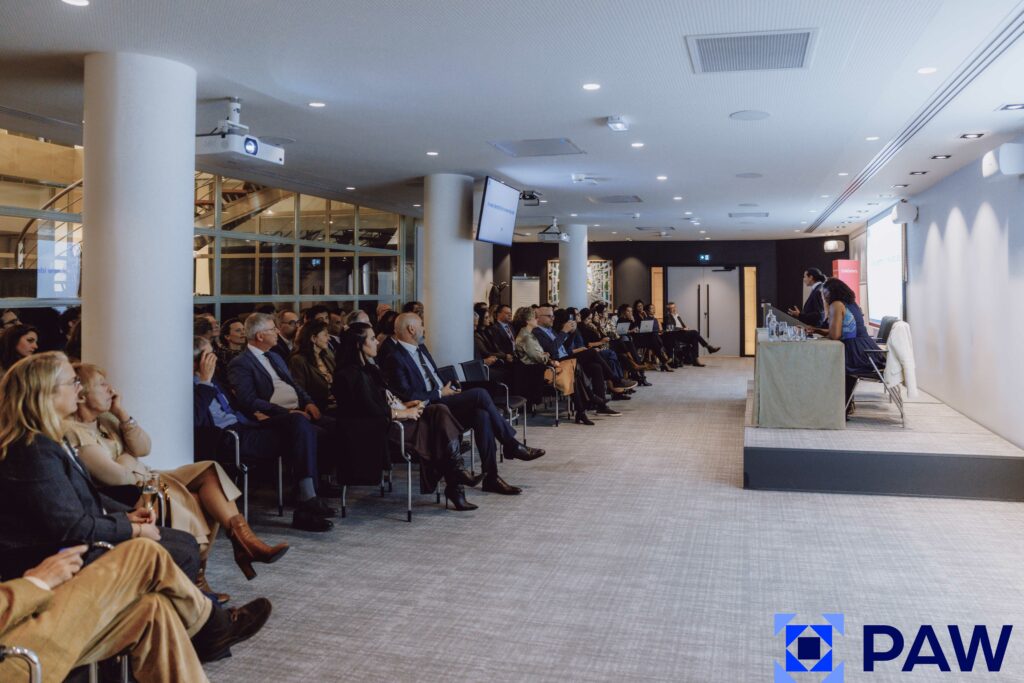
On 17 November 2025, Paris Arbitration Week (“PAW”) marked its 10th anniversary with a launch event hosted by Linklaters in Paris, unveiling a new identity, expanded initiatives, and a fellowship program designed to shape the next decade of international arbitration. What started as an ambitious gathering of practitioners ten years ago has grown into a worldwide institution with its own emblem, ecosystem, and educational purpose.
The evening opened with remarks by Catherine Schroeder, Independent Arbitrator, Founding Partner of Schroeder Arbitration and Co-President of the PAW Organising Committee, who welcomed the community and set the tone for the 10th-anniversary launch. She then handed the floor to Alexandre Vaghenheim, VP of Global Legal Data at Jus Mundi and Vice-President of the PAW Organising Committee, who presented the new identity and digital universe. Diamana Diawara, Director for Dispute Resolution Services in Africa at International Chamber of Commerce (ICC) and Co-President of the PAW Organising Committee, later outlined key reforms to partnerships and guiding principles, unveiled the PAW Fellowship, and acknowledged the founders and board members who shaped the institution over the past decade.
Together, their messages converged on a central theme: PAW is stepping confidently into its next era—more open, more interconnected, and more globally inclusive.
A New Identity for a New Decade
The centerpiece of the launch was PAW’s new visual identity, symbolizing its transition from a yearly event to a recognized institutional actor in the arbitration world.
Alexandre explained that the rebrand was not merely cosmetic but conceptual. “PAW today is a global institution,” he noted, highlighting how the community’s growth demanded an identity that reflects its value, permanence, and international reach.

The foundation of this new identity is an emblem that reimagines the traditional logo. Its geometric design draws inspiration from the iconic lattice structure of the Eiffel Tower, capturing the sense of interconnection and structural strength that has defined PAW’s trajectory. Its outer corners represent PAW’s foundational pillars: learning, sharing, celebrating, and togetherness. Its inner corners reflect the core themes that guide PAW’s programming and values: rule of law, innovation, diversity, and sustainability. At its centre sits a unifying square, symbolising PAW as a meeting point that connects the global arbitration community.
“This emblem is not just a design; it tells our story and the story of the community that built PAW over the last decade.”
The visual identity, he emphasized, is intended to resonate “immediately and internationally,” signaling PAW’s position in the global arbitration ecosystem.
This emblem now connects a broader, restructured “PAW Universe” comprising partners, media initiatives, knowledge resources, networking platforms, and the new mobile PAW Pass.
A Rebuilt Website and Smarter Digital Tools
Alongside its new identity, PAW revealed a completely redesigned website. The new platform has been rebuilt from the ground up to enhance accessibility and event management for both partners and participants.
Key features include:
- Smart invitation tools: Partners can now send personalized invitations or invite entire lists at once.
- Quick registration management: Requests to attend can be validated or declined instantly.
- PAW Checking App: A new application enabling simultaneous registration and attendance tracking. The tool is designed to help partners and institutions better measure engagement and return on investment.
These innovations reflect PAW’s commitment to continuous improvement: every major feature added in this redesign emerged from user feedback gathered over the past editions. The result is a modernized platform capable of supporting PAW’s programming and community growth in the years ahead.
A New Brand Universe: Library, Networking & Press
With its new emblem and website, PAW has formalized a broader ecosystem—one that transcends the annual week of events.
PAW Digital Library
Created to centralize and curate knowledge sharing, the library will continue to expand through collaboration with institutional and academic partners. It aims to become a permanent reference point for arbitration resources and thought leadership.
PAW Networking
Introduced in recent years, this tool enables participants to identify who is attending which events during PAW. It has become a valuable connector, facilitating meaningful meetings that extend beyond formal panels.
PAW Press
PAW’s media initiatives—including PAW On Air—now fall under a unified Press section. This pillar is expected to grow alongside PAW’s communication strategies, amplifying the reach and visibility of arbitration-related content.
PAW Pass
A new mobile application designed to streamline participation across the week. PAW Pass enables instant event registration and facilitates smoother on-site access, making attendance easier and more seamless for the community.
Together, these programs reinforce PAW’s ambition to operate not only as a week-focused platform but as a year-round institution dedicated to education, community-building, and access to knowledge.
A More Accessible Partnership Model and Renewed Guiding Principles
Diamana then introduced another major announcement concerning PAW’s expanded partnership model. Recognizing the diversity of organizations involved in arbitration, PAW introduced a new partnership tier designed for smaller firms and boutique practices. This initiative aims to make participation more accessible while preserving PAW’s principle of equal treatment for its partners.
As part of this structural evolution, PAW also reaffirmed its ten guiding principles, including innovation, sustainability, and the rule of law. One principle was highlighted with particular insistence: diversity and inclusion.
Quoting Yasmin Mohammad, Alexandre reaffirmed the organization’s long-standing stance:
“We will continue to talk about diversity until it is no longer an issue.”
He echoed this commitment, emphasizing that diversity is not only a value but an operational priority. “We see PAW as a mirror of the community it represents,” he said.
With this renewed focus, PAW’s rebrand becomes a tool not only for identity but for governance and accountability in shaping a more inclusive arbitration ecosystem.
The PAW Fellowship: A Flagship Program for Global Talent
Building on this commitment to broader representation, Diawara concluded the evening with the announcement of the PAW Fellowship. This program aims to foster arbitration talent worldwide, especially in regions with limited access to arbitration resources and professional opportunities.
The Program
The Fellowship’s goal is to identify promising practitioners, provide them with structured educational programming, and invite them to Paris during PAW to experience the full breadth of its events, community, and networking opportunities.
Fellows will participate in a curated series of lectures and seminars focusing on international arbitration. During PAW, they will engage with panels, workshops, and institutional events, exposing them to the diversity and quality of programming from PAW’s partner organizations.
Post-PAW Mentoring
The Fellowship includes a mentoring component led by partner firms, coordinated by Athina Fouchard. The program guarantees that fellows continue to receive meaningful guidance, feedback, and professional support even after PAW concludes.
Selection Criteria
Eligibility requirements are detailed on the new PAW website. It’s aimed at legal professionals with at least three years’ experience in dispute resolution, based in Asia or Africa.
Applications are open until 31 December 2025, with selections expected to be announced by mid-January 2026.
The Fellowship embodies PAW’s ambition to translate its values into concrete, long-term initiatives.
Conclusion
PAW’s 10th anniversary marks more than a milestone—it marks the beginning of a new phase. With its new emblem, digital ecosystem, expanded partnership structure, and the launch of the PAW Fellowship, the organization is positioning itself as a leading global platform for arbitration dialogue, education, and community building defined by openness, innovation, and inclusion.
The evening closed with warm thanks to the teams behind the rebranding effort, the founding members who set PAW in motion ten years ago, and the current and former board members who continue to guide its evolution. Their collective work has shaped PAW into what it is today: a dynamic, interconnected community committed to advancing international arbitration.
The rebranding is as symbolic as it is strategic: PAW is no longer just a moment in the calendar. It is a permanent, evolving institution with a mission shaped by its diverse, international community.
The upcoming decade of PAW is set to involve more active participation, increased accessibility, and a greater worldwide influence, all rooted in the core principles represented by the new emblem.
About Jus Mundi
Founded in 2019 and recognized as a mission-led company, Jus Mundi is a pioneer in the legal technology industry dedicated to powering global justice through artificial intelligence. Headquartered in Paris, with additional offices in New York, London, and Singapore. Jus Mundi serves over 150,000 users from law firms, multinational corporations, governmental bodies, and academic institutions in more than 80 countries. Through its proprietary AI technology, Jus Mundi provides global legal intelligence, data-driven arbitration professional selection, and business development services.
*The views and opinions expressed by authors are theirs and do not necessarily reflect those of their organizations, employers, or Daily Jus, Jus Mundi, or Jus Connect.