
THE AUTHOR:
Clémence Prévot, Director of Publications at Jus Mundi
The Juris Arbitration Law Library has become one of arbitration’s most relied-upon references, built for the way arbitration practitioners actually work, strong in international commercial arbitration, with a particular depth in US practice and procedure, and a solid secondary layer in investment arbitration.
Today, that library gets significantly deeper. We are adding 17 new titles, covering everything from tribunal conduct and witness examination to post-award enforcement, US court support, and investment treaty jurisprudence.
The Importance of the JURIS Library
The strongest research libraries earn their reputation on the questions they help you answer. This expansion earns it twice over: in commercial arbitration and in US practice.
At the practitioner end, updated editions of the Leading Arbitrators’ Guide and the College of Commercial Arbitrators Guide brings one of the field’s most-cited references, while The Dark Side of Arbitration offers a rare, unflinching look at how arbitrators and institutions actually fail. On the other side of a case, Defeating and Defending Awards and the updated Public Policy Exception under the New York Convention gives counsel practical tools for enforcement.
A Deeper Bench for US Practice
The US layer is where the depth is hardest to find elsewhere. Section 1782 discovery, interim measures across US courts, FINRA securities procedure, and reasoned award standards are the kind of jurisdiction-specific guidance generalist resources simply don’t carry, exactly what international teams need the moment a dispute touches US courts.
Beyond commercial practice, an 18-volume treatment of ISDS jurisprudence, alongside focused work on jurisdictional boundaries and natural-resources disputes, gives treaty specialists one of the deepest secondary-source collections available. And for counsel working a specific seat or sector, new titles on the EU’s post-Achmea landscape, Asia-Pacific force majeure, and construction delay analysis mean the guidance is built for the matter in front of you, not written in generalities.
The result is a library that now runs the full length of a case: from the tactics that shape a strategy, through the treaty and regional law that frame a dispute, to the arguments that decide whether an award survives enforcement. That range, across commercial, investment, US, EU, construction, and financial services practice, is what makes JURIS the most comprehensive arbitration library on any legal intelligence platform.
Standout Titles
Among the library’s existing titles, a few stand out for breadth of practitioners they already serve:
- American Review of International Arbitration (ARIA): the top US journal on international arbitration, with a strong academic and DEI focus, a natural fit alongside this expansion’s US-practice depth.
- ASA Special Series: practical Swiss Arbitration Association analyses on good faith, institutional scrutiny, and expert evidence.
- International Arbitration Institute (IAI) Series: curated IAI conference proceedings on state entities, precedent, and jurisdictional challenges.
The Full List: 17 New Titles
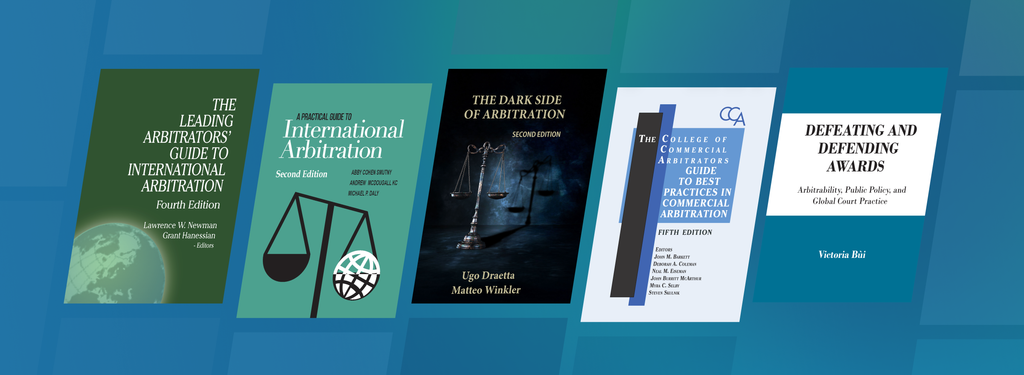
- Leading Arbitrators’ Guide to International Arbitration, 4th Ed. (Newman & Hanessian, 2025): tribunal conduct, procedure, evidence, awards, and enforcement in one reference.
- The Dark Side of Arbitration, 2nd Ed. (Draetta & Winkler, 2026): arbitrator misconduct, institutional failures, and arbitration ethics.
- College of Commercial Arbitrators Guide to Best Practices in Commercial Arbitration, 5th Ed. (Barkett et al., 2025): practitioner-led guidance across the stages of commercial arbitration, updated for AI and modern case management.
Flagship Practitioner References
- Defeating and Defending Awards: Arbitrability, Public Policy, and Global Court Practice (2026): a comparative playbook for challenging and defending awards.
US Practice and Procedure in International Arbitration
- Obtaining Evidence for Use in International Tribunals under 28 U.S.C. § 1782, 2nd Ed.: guidance on using US federal discovery in support of foreign and international proceedings.
- Interim Measures in the United States in Aid of Arbitration (Newman, Brand & Lowry): state-by-state analysis of how US courts grant, review, and coordinate interim relief.
- The Reasoned Arbitration Award in the United States: Its Promise, Problems, Preparation, and Preservation (McArthur): practical guidance on drafting and analyzing awards in the US context.
- Securities Arbitration: Practice and Forms, 4th Ed. (Maglich & Rice): a FINRA-focused guide to procedure, pleadings, forms, and strategy in securities disputes.
Advocacy, Evidence, and Scholarship
- Take the Witness: Cross-Examination in International Arbitration, 2nd Ed. (Newman & Nelson): witness examination, preparation, and cross-examination technique.
- Construction Schedules: Analysis, 5th Ed.: delay and schedule analysis for construction and engineering disputes.
- Law and Practice of International Arbitration: Essays in Honor of John Fellas (Campos, Moubarak, Shokalo & Forno Odría, eds.): essays on procedure, advocacy, ethics, and the development of international arbitration.
Investment Treaty Arbitration and Public International Law
- Investment Treaty Arbitration and International Law, Vols. 1-18 (Weiler & Duggal): BIT jurisprudence, standards of treatment, procedure, and emerging ISDS trends.
- The Boundaries of Investment Arbitration (Alvarez): the limits of investment arbitration and its relationship with WTO trade law, European human rights law, jurisdiction, and applicable law.
- Natural Resources and the Law of the Sea: Exploration, Allocation, Exploitation: specialized coverage for energy, mining, maritime, and natural-resources disputes.
Regional and Thematic Coverage
- Force Majeure and Hardship in the Asia-Pacific Region (Sippel & Duggal, eds.): country reports across 17 Asia-Pacific jurisdictions, relevant to contractual disruption and supply-chain disputes.
- The Impact of EU Law on International Commercial Arbitration (Ferrari, ed.): competition law, public policy, and the post-Achmea and Komstroy landscape.
- Practitioner’s Guide to the CISG, 2nd Ed. (Ferrari, ed.): a practical reference for cross-border sale contracts and commercial arbitrations applying the CISG.
Expanding Your Research Toolkit
More value, same price. If you already have JURIS access or Jus AI Max, all 17 titles are added automatically. No new contract, no additional charge.
Full lifecycle coverage. From strategy and witness preparation through to award drafting, challenge, and enforcement, the new titles fill in practical guidance at every stage of a commercial arbitration matter.
Deeper US practice support. Section 1782 discovery, interim measures in US courts, securities arbitration, and reasoned awards give US-based practitioners, and international teams with US exposure, a stronger toolkit.
Authoritative, current authorship. The batch includes work from leading names in the field, including Lawrence W. Newman, Grant Hanessian, Todd J. Weiler, Kabir Duggal, Ugo Draetta, José Alvarez, and Franco Ferrari, alongside new or updated 2025-2026 editions.
Doctrine Meets Agentic AI
Adding 17 titles to a library is only half the story. What makes this expansion count is where that content lives: inside the same research environment as Jus Mundi‘s case law, treaties, and Jus AI.
Ask Jus AI a question, and it can draw on JURIS publications alongside awards and treaties in a single query, so you move from what leading commentators say to the authorities that support it, without opening a second tool. Every insight sourced from a JURIS title comes with a traceable path back to the original text, the same transparency Jus AI applies across the database, so you can check the source before you rely on it.
Whether you are scoping a novel legal issue or preparing for a hearing, Jus AI can pull together the relevant commentary and case law in a fraction of the time manual research would take, freeing you to focus on strategy rather than the search itself.
And the support does not stop at research. From early legal analysis to drafting support and arbitrator selection, having JURIS’ practitioner guidance available inside Jus AI means the platform can help at more stages of a case, not just at the research stage.
Start Exploring
JURIS is an add-on library: Explore the JURIS Arbitration Law Library. If you already have JURIS access, the new titles are live in your library today. Explore what’s new.
These publications (like all our libraries) are fully integrated into Jus AI. With Jus AI, search across publications, awards, treaties, and primary sources in one place. Query doctrine and jurisprudence together, identify relevant connections, and surface the authorities needed to support your argument.
About Jus Mundi
Jus Mundi is the AI-powered global arbitration intelligence platform. Built by international arbitration practitioners, the company architected its intelligence platform specifically for arbitration’s unique demands. Leveraging partnerships with over 110 arbitral institutions, publishers, and associations worldwide, Jus Mundi serves more than 700 leading arbitration teams through three integrated experiences: Jus Mundi for multilingual research, Jus Connect for professional selection, and Jus AI for agentic reasoning. With offices in Paris, New York, London, Singapore & Mexico City, Jus Mundi is committed to powering global justice by democratizing access to legal and arbitration intelligence globally.
For more information, visit https://jusmundi.com/en/jus-ai.

*The views and opinions expressed by authors are theirs and do not necessarily reflect those of their organizations, employers, or Daily Jus, Jus Mundi, or Jus Connect.