
Lawyering Plus Webinar: S2 EP4
THE AUTHORS:
Lucian Ilie, Barrister at Outer Temple Chambers
Mihaela Apostol, Independent Counsel and Arbitrator
“As the legal profession continues to evolve, it’s clear that success today demands more than just technical ability. Networking isn’t just about collecting contacts—it’s about cultivating relationships that grow with your career. Learning to navigate networking with confidence, authenticity, and purpose can transform professional opportunities.”
About Lawyering Plus
Lawyering Plus is an initiative set up by Mihaela Apostol, Dr Ilka Beimel, and Svetlana Portman to help lawyers build soft skills. Lawyering Plus organises webinars and invites expert speakers to share tips on a particular soft skill. Each episode ends with an interactive Q&A segment. The first season focused on communication skills, followed by season two on Business Development & Branding.
Fourth Episode: Networking
In today’s competitive professional landscape, networking is often misunderstood as a transactional activity focused on short-term gains. In a recent discussion, Lawyering Plus spoke with Lucian Ilie about what effective networking truly entails. Drawing on more than 15 years of experience across diverse legal cultures (including France, the United Kingdom, and the United Arab Emirates), Lucian has developed a nuanced understanding of professional interactions. His insights reframe networking as a component of long-term business development and professional identity. Rather than being an isolated task, networking is presented as the starting point of a broader process: building meaningful relationships grounded in authenticity, trust, and reciprocity.
Networking Is a Door Opener
Lucian Ilie describes networking as a door opener. It is only the first phase of a much longer journey, an initial interaction that creates the possibility for future collaboration.
However, the real value lies in what follows. The second phase involves “keeping the door open,” which means maintaining contact, nurturing relationships, and gradually building trust.
One of the most important mindset shifts, Lucian emphasises, is the need to approach networking with a long-term vision. Many professionals, especially juniors, expect immediate returns from networking efforts. When those expectations are not met, they become discouraged. Lucian challenges this approach, explaining that most networking interactions will not produce immediate opportunities. Instead, networking should be treated as a long-term business plan, where results may emerge months or even years later.
Lucian identifies three essential qualities that define a strong networker. These traits form the foundation of meaningful professional relationships.
- Authenticity: Effective networkers are genuine, approachable, and natural in their interactions. They do not treat networking as a performance or a sales pitch.
- Listening: Networking is described as a two-way process, yet many people tend to dominate conversations with self-promotion. Show curiosity and allow others to share their perspectives.
- Reciprocity: Shift the focus from “What can I get?” to “How can I help?”
Where to Start
Lucian cautions against feeling pressured to generate clients early in one’s career. Instead, one should focus on observing how experienced professionals interact and building confidence gradually. Importantly, even junior professionals can contribute value. Simple actions, such as making introductions or sharing information, can be meaningful and come at no cost.
To address the common fear of networking, Lucian simplifies the process: treat it as a conversation, not a transaction. A simple step-by-step approach is as follows:
- Start by introducing yourself briefly;
- Ask 2-3 open-ended questions;
- Based on the answers received, see if there are any areas of common interest to continue the conversation and build a rapport.
Preparation Matters: Choosing the Right Events
Effective networking begins before the event itself. Lucian highlights the importance of strategic event selection, particularly as professionals become more senior.
Key considerations include:
- Budget and time constraints (maybe pick 3-4 big events per year);
- Relevance to one’s practice area;
- The profile of attendees and speakers;
- Opportunities to contribute (e.g., speaking roles).
Preparation should also include identifying 3-4 potential individuals in advance to connect with, by familiarising yourself with their work and considering how you can contribute. This targeted approach is far more effective than attempting to meet as many people as possible.
Lucian advises attending events outside your specialisation. For example, if your practice is primarily in arbitration, you might consider attending events on finance or compliance. Similarly, if you are active in a particular industry, such as tech or oil and gas, make sure you attend events where industry professionals are present.
How to Focus on Client and Business Needs During a Pitch?
Turning to the pitch itself and the difficult question of how to focus on the client and business needs during the pitch, Charlie highlighted one key aspect: listen first. Ask what outcome the client truly wants. Charlie emphasised that clients’ objectives are not always to “win” at all costs – early settlement or commercial solutions may be preferred. Be ready to pivot strategy in response to client goals.
Other considerations when focusing on client and business needs during the pitch are, first, demonstrating the ability to problem‑solve in the moment – that distinguishes you from equally technically capable competitors – and second, to address fee sensitivity proactively. Provide cost frameworks and options so in‑house teams can present realistic budgets internally.
Demonstrating Competence and Building Trust
Trust is a critical outcome of networking, and Lucian explains how it can be developed organically. Rather than listing credentials, professionals should convey their expertise through conversations about their work and experience:
- Discuss recent cases they worked on;
- Share insights from a publication they prepared/read;
- Offer insights from other events or projects.
These examples demonstrate competence in a natural and engaging way.
Equally important is honesty. Admitting when something is outside one’s expertise can actually strengthen credibility. Authenticity and transparency are key to building lasting trust.
Follow-Up: Turning Contacts into Relationships
Networking does not end when the event concludes. Follow-up is essential to transforming initial interactions into meaningful relationships.
Lucian outlines a practical approach:
- On the very same day, if possible, connect on LinkedIn shortly after the event with a personalised message (e.g., “It was great meeting you. Happy to connect, I hope to have the chance to discuss/catch up later on topic X”).
- For those with whom you established a stronger connection and common areas of interest, follow up via email within 48 hours, so they have your email handy in case they need to reach out to you in the future.
- Suggest a meeting, such as coffee or lunch, as a follow-up.
This progression helps deepen the relationship over time.
However, moderation is important. Over-communication, such as frequent generic newsletters, can become counterproductive and damage the relationship.
Accessing Clients: Rethinking Assumptions
The discussion also challenges common assumptions about accessing clients.
Lucian notes that:
- Decision-making is not limited to senior partners;
- Senior associates often play key roles;
- Peer relationships can evolve into client relationships over time.
He also suggests practical strategies:
- Use LinkedIn to identify relevant individuals within the targeted industry (the general counsel, the head of legal, etc.);
- Target those events where those individuals are speaking or attending;
- Ask mutual connections to make an introduction (rather than sending a direct message).
After establishing first contact, see if there are common areas: if studied at the same university, publication of an article on a topic of interest, etc.
Final Thoughts: A Human Approach to Networking
The overarching message of the discussion is that networking is not about volume, visibility, or immediate results. It is about people.
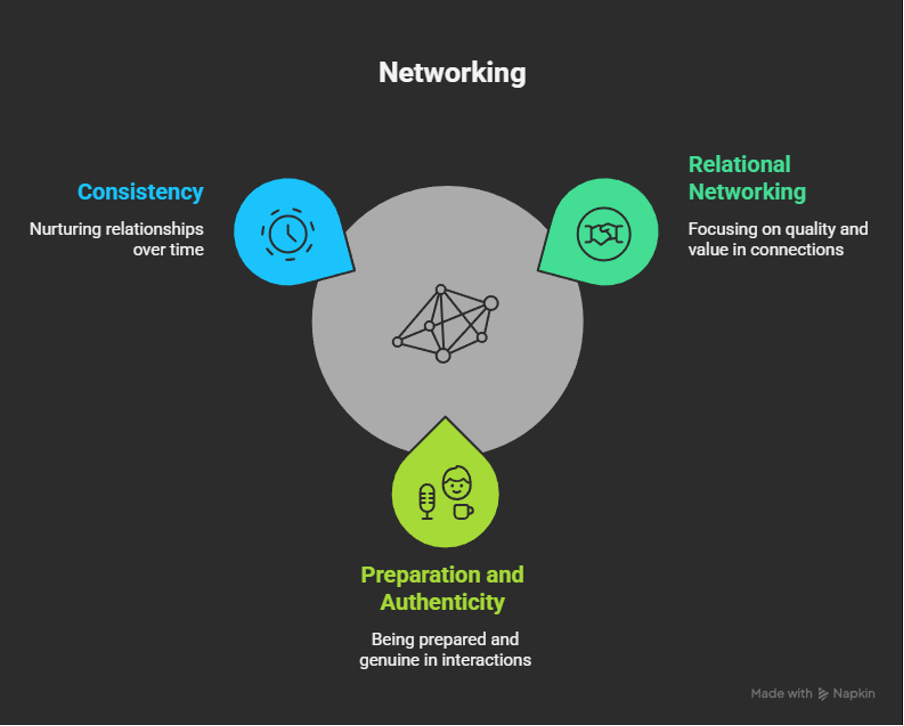
Effective networking requires: authenticity, consistency, a willingness to help others and a long-term perspective. These principles closely mirror those involved in building a strong business persona: knowing who you are, communicating it clearly, and showing up consistently.
Ultimately, networking is less about “working the room” and more about building relationships that endure. By focusing on genuine connections rather than transactional outcomes, professionals can create a network that supports both personal and professional growth over time.
Next Episodes
The recording of this episode is available here.
Follow Lawyering Plus on LinkedIn to receive updates on future episodes and learn more about soft skills, or register here. Subscribe to the Lawyering Plus YouTube channel to receive notifications when new recordings become available.
ABOUT THE AUTHORS
Lucian Ilie is an experienced English barrister at the Commercial Bar, a registered advocate with ADGM and DIFC courts (UAE) and a French and Romanian avocat, specialised in international law, transnational litigation and international arbitration, with particular expertise in investor-State disputes and commercial arbitration cases. In addition to his counsel work, Lucian sits as arbitrator (Chair/Sole arbitrator/Co-arbitrator).
He is recognised in Legal500 (London Bar) as a Leading Junior in Public International Law and by GAR’s Lexology Index (former Who’s Who Legal) as a “Global Elite Thought Leader” in international arbitration, being considered in England “a well-regarded and very knowledgeable practitioner with particular expertise in investment law and intra-EU arbitration”.
Mihaela Apostol is an Independent Counsel and Arbitrator based in London. Mihaela is a civil and common law qualified lawyer with over 10 years of experience in international arbitration, having worked as counsel, tribunal secretary and arbitrator. She is an Avocat of the Bar of Bucharest, Romania and a Solicitor of the Supreme Court of England and Wales.

*The views and opinions expressed by authors are theirs and do not necessarily reflect those of their organizations, employers, or Daily Jus, Jus Mundi, or Jus Connect.