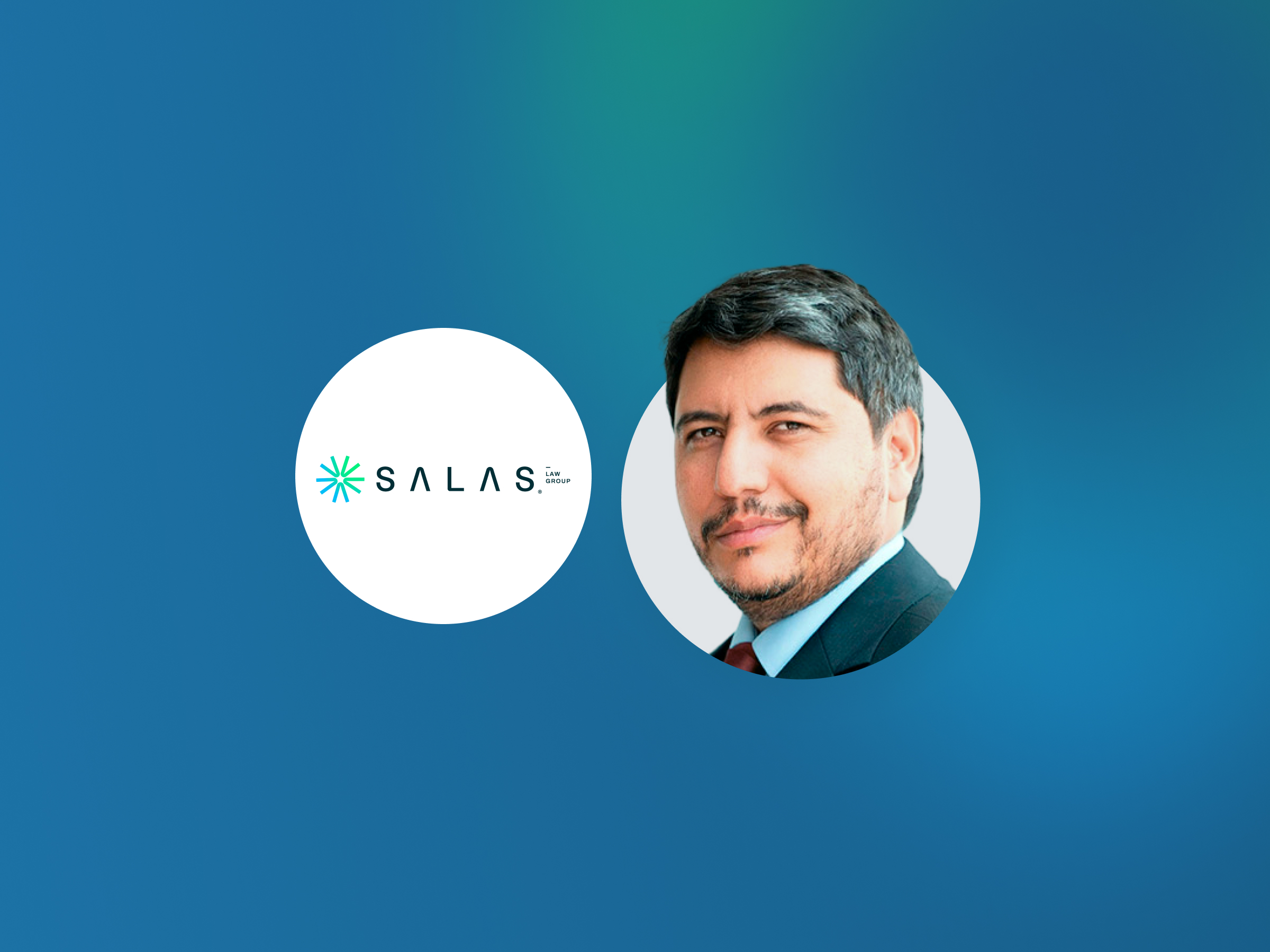
In conversation with Guillermo Salcedo Salas, Partner at Salas Law Group
“It’s not just a database, it’s case strategy that we’re developing with Jus AI.”
Guillermo Salcedo Salas
Partner, Herbert Smith Freehills Kramer
Results at a Glance
| Outcome | Result |
| Research time | Significantly reduced across both arbitration and maritime and port law matters |
| Client certainty | Faster, evidence-backed guidance on likely dispute outcomes, drawn from recent global awards |
| Case strategy | Jus AI functions as a real-time reasoning partner, surfacing relevant case law beyond initial research scope |
| Document analysis | Confidential vault enables cross-referencing of case documents against the global awards and doctrine database |
| Competitive positioning | Boutique firm delivers research depth comparable to large international law firms |
About the Firm
Salas Law Group is a boutique firm headquartered in Bogotá, Colombia, with two niche practices: Maritime and Port Law, and Arbitration and Dispute Resolution. The firm advises state entities and private companies operating across Latin America and Europe, with a particular focus on international commercial and investment arbitration, infrastructure disputes, maritime and port concessions in Colombia, litigation before Colombian courts, and London-seated arbitration for shipping disputes.
Salas Law Group was founded in 1993 by Elizabeth Salas Jiménez, one of the leading authorities on maritime and port concessions in Colombia. Guillermo Salcedo Salas joined the firm in December 2025 as Partner to lead its Arbitration and Dispute Resolution practice, after training and practicing at leading international firms in Paris for more than a decade. He has acted in more than forty arbitrations under ICC, ICSID and UNCITRAL rules and has represented companies, State entities and States including Venezuela, Ecuador, Peru, Colombia, Algeria and Egypt in international proceedings. Free of the conflicts of interest that come with large firms, he now also accepts appointments as arbitrator.
The combination of international arbitration expertise and maritime law in a boutique setting is unusual for a boutique firm. It is precisely that dual ambition, and the commitment to deliver it at the highest level without a large firm’s infrastructure, that made adopting the right legal technology a strategic priority.
The Opportunity
Operational Challenge
At the large international law firms where Guillermo spent the earlier part of his career, research was a function of scale. Teams of associates and interns handled the volume and cases were staffed heavily. The model worked because the resources existed to support it.
Leading a practice within a boutique firm changed that equation.
“Before Jus AI, at large law firms, we would have armies of interns and general associates who would do the research.”
Even with access to Jus Mundi’s database, Guillermo understood that volume of data alone was not the answer. The challenge was not finding material. It was reading it, synthesizing it, and identifying what was actually relevant, quickly enough to matter.
“When you have such a large database, that does not alleviate the requirements of reading, synthesizing, and finding the right case law, doctrine, or whatever you need for the case.”
Strategic Challenge
Salas Law Group’s dual practice creates compounded research demands. International arbitration matters require engagement with awards, procedural decisions, institutional practice, and doctrine across multiple legal traditions. Maritime disputes involving London-seated proceedings require current knowledge of English shipping law and recent awards. For clients whose businesses sit at the intersection of both, the research burden is substantial.
At the same time, clients managing live disputes expect speed and directional certainty. They need to understand their position now, not several weeks later. Delivering that responsiveness, without the support structure of a large firm, required a fundamentally different approach to how research is conducted.
The Solution
When Guillermo evaluated tools for the new practice, he cast a wide net. The market for AI legal research tools is growing quickly, and many products were considered. But the requirements for Salas Law Group were specific: the tool had to serve both international arbitration and maritime law with genuine depth.
“We looked into many tools and many products that are out there, but there isn’t one similar to Jus Mundi and Jus AI that is tailored for the international arbitration practice plus our other core practice, maritime and port law. This is the only tool that actually ticked both boxes for us.”
Beyond coverage, a key differentiator was transparency. Generalist AI tools are often described in the industry as a “black box”: they return answers without showing how they were reached.
“What we particularly liked about Jus AI is the fact that you can see how it’s thinking. You can see what sources it’s consulting so that you can do some sort of reverse engineering. When you get the final answer, you can go step-by-step and check how it’s thinking.”
That visibility does more than build trust; it generates ideas. Seeing the path the tool took to reach an answer often opens up new angles for argument and case presentation.
Additional factors that confirmed the decision:
- Access to the ICC Dispute Resolution Library: Enabling an understanding of how arbitrators decide, how awards are scrutinized, and how annulment proceedings are developing
- Access to recent English shipping law awards: Directly relevant to London-seated maritime arbitration work
- Access to French legal doctrine: Critical for Latin American jurisdictions whose highest courts regularly reference French civil law sources
- A confidential document vault: Allowing case documents to be uploaded and cross-referenced against the global database securely
- An expanding ecosystem: New sources, integrations, and capabilities added continuously
The Impact
Research Time Is Diminishing
The most immediate change has been speed. Research that previously required significant time and personnel is now completed far faster.
“The research time is going down. We are capable of finding the answers very quickly.”
For clients managing active disputes, that speed is not merely convenient. It is reassuring.
“This is of particular importance to clients who are handling disputes and need to be reassured on more or less what the outcome might look like.”
A Thinking Partner, Not Just a Search Tool
What distinguishes Jus AI most sharply in Guillermo’s experience is not speed alone. It is the quality of intellectual engagement.
“What I find gives particular value to Jus AI is the fact that as a partner in a boutique firm, I have found a tool I can spar with, have a conversation with. It’s going to double-check my legal reasoning. It’s going to show me case law that perhaps was not on my radar.”
This is a different category of tool. Rather than retrieving documents for a lawyer to then analyse independently, Jus AI participates in the analytical process itself. It challenges reasoning, surfaces overlooked material, and opens up new lines of argument. The result is stronger, more complete legal analysis, built faster than before.
“It’s not just a database, it’s case strategy that we’re developing with Jus AI.”
Giving Clients Certainty in Dispute Planning
Guillermo’s partner, Elizabeth Salas Jiménez, is one of the leading authorities on maritime and port concessions in Colombia.
“A number of clients seek us not only because we are experts in maritime law in Colombia, but also because they want to know what happens if the execution of the contract goes wrong and they have to go to a dispute resolution environment, which will usually be London.”
For clients in the maritime and international trade sectors considering or facing London-seated arbitration, the ability to track the current state of English shipping law has become a concrete and valued service offering.
“Jus Mundi and Jus AI allow us to look into how the cases are being resolved. So this is something that our clients appreciate: we can tell them, look, if you end up in arbitration, we are seeing these recent awards and this is the current status of English shipping law. So that allows us to provide a bit more certainty to the client.”
Clients are no longer simply asking whether a firm has arbitration experience. They are asking what that firm knows, right now, about the direction of the law. Jus AI makes it possible to answer that question with authority.
Opening Access to Doctrine That Was Previously Out of Reach
For Salas Law Group’s Latin American clients, one of the most strategically valuable features of Jus Mundi and Jus AI is access to French legal doctrine. Civil law jurisdictions across the region frequently cite French sources at the highest judicial levels, including the Colombian Supreme Court of Justice. That doctrine, historically difficult to access outside major international firms with Paris offices, is now available to a boutique in Bogota.
“We do come across some decisions from the Supreme Court of Justice in Colombia that make a reference to articles from the Revue de l’arbitrage dating back to the 1990s or even 1980s. The French doctrine is really respected and adopted by local courts, not the minor courts, the Supreme Court of Justice, which is the highest court in the land in Colombia. The ability to have access to the doctrine allows us not only to deliver our arguments on the law, but also have the authorities to support it.”
Arbitration Intelligence That Shapes Strategy
On the arbitration side, access to the ICC Dispute Resolution Library has given Guillermo a window into institutional decision-making that directly informs how cases are built and how clients are advised.
“The fact that we have access to the ICC dispute resolution library is allowing me to determine how arbitrators are deciding cases, how the ICC is scrutinizing awards, what’s happening at some point with the annulment of awards, to inform me and to educate me into the arbitration world.”
This is not background research. It is live intelligence feeding directly into the strategic advice Salas Law Group provides to its clients.
Elite Research, Boutique Practice
Guillermo Salcedo Salas built his career at the top of international arbitration: representing mainly states, working across continents, operating within some of the world’s most resourced law firms. He brought that experience back to Colombia, to a firm with more than three decades of leadership in the maritime and port sector.
What Jus AI has made possible is that practicing within a boutique did not require a compromise on depth, rigour, or client value. The research capability, the strategic intelligence, the access to doctrine and awards across jurisdictions: all of it travels with him.
“With Jus AI, size stops being the advantage. This is what levelling the playing field actually looks like.”
Ready to see how Jus AI can transform your arbitration practice?
Book a personalized demo today and experience the speed, accuracy, and confidence that leading firms like Three Crowns rely on.