
Lawyering Plus Webinar: S2:E5 Thought Leadership
THE AUTHORS:
Naomi Briercliffe, Partner at Squire Patton Boggs
Svetlana Portman, Associate at Debevoise & Plimpton
“Thought leadership is a way of staying relevant – demonstrating your expertise so that clients know where you are when they need you.”
About Lawyering Plus
Lawyering Plus is an initiative set up by Mihaela Apostol, Dr Ilka Beimel, and Svetlana Portman to help lawyers build soft skills. Lawyering Plus organises webinars and invites expert speakers to share tips on a particular soft skill. Each episode ends with an interactive Q&A segment. The first season focused on communication skills, followed by season two on business development and branding. You can read about the previous episodes here.
Fifth Episode: Thought Leadership – Building Your Voice in the Market
On 23 February 2026, Lawyering Plus welcomed Naomi Briercliffe, Partner at Squire Patton Boggs, for an engaging and practical presentation on thought leadership. Drawing on her extensive experience across international arbitration, litigation, and sitting as an arbitrator, she shared actionable guidance on how lawyers can build visibility through writing and speaking, develop a distinctive professional voice, and use thought leadership as a tool for career progression and business development.
What is Thought Leadership?
Naomi began by addressing the concept of thought leadership, defining it as establishing oneself as an expert in a particular field while shaping discourse and offering forward-looking insights.
At its core, thought leadership is about building a professional brand that creates authority and trust. It enables lawyers to:
- Strengthen relationships with existing clients.
- Attract new clients.
- Differentiate themselves in a competitive market.
- Enhance their internal profile within the firm.
While technical excellence remains fundamental, Naomi emphasised that many lawyers are highly skilled. Thought leadership is what helps a lawyer stand out.
Thought leadership plays a crucial role for disputes practitioners in particular. Unlike transactional lawyers, disputes lawyers may not have continuous client engagement. Publishing and speaking allow them to remain visible and relevant between instructions.
Finding Your Focus
A central theme of the session was the importance of identifying a clear focus. Thought leadership requires time and effort, making it essential to target the right areas. Naomi suggested starting with a structured reflection:
- Review past cases and clients to identify patterns (sector, geography, or type of work).
- Consider additional skills such as languages or prior experience.
- Draw on personal background or ongoing life experiences.
- Identify topics that genuinely motivate and interest you.
Having a credible connection to a chosen topic strengthens authenticity and helps develop a compelling narrative. While it is possible to pivot into new areas, Naomi noted that this often requires more time and deliberate effort. Importantly, motivation is key—sustaining thought leadership alongside billable work is challenging without a genuine interest in the subject matter.
Thought Leadership Through Writing
Naomi outlined three common forms of written thought leadership, each with distinct advantages:
- Client bulletins:
- Short and practical.
- High value for time invested.
- Limited scope for expressing personal views.
- Short-form articles (e.g., blogs, industry publications):
- Allow more analytical depth.
- More likely to reach wider audiences.
- Effective for building recognition.
- Academic writing:
- Enhances credibility in certain fields.
- Time-intensive with less direct client impact.
- Should be approached selectively.
A key takeaway was the importance of promotion. Writing alone is not sufficient, lawyers must actively ensure their work reaches the intended audience. This can include:
- Directly sharing publications with clients.
- Leveraging firm distribution channels.
- Publishing through external platforms (e.g., blogs, journals, trade publications).
- Collaborating with colleagues who have established profiles.
- Using social media, particularly LinkedIn.
Naomi also highlighted the value of “dual use”: repurposing written work into other formats, such as presentations or webinars, to maximise impact.
Thought Leadership Through Speaking
Speaking engagements are another powerful form of thought leadership, encompassing:
- Internal presentations.
- Client webinars.
- Firm-hosted events.
- Third-party conference.
- Academic lecturing.
Naomi emphasised that internal speaking opportunities are often the most accessible starting point. Presenting within the firm can build confidence and visibility, leading to external opportunities.
Practical strategies for securing speaking engagements include:
- Expressing interest to mentors and senior colleagues.
- Getting involved in professional organisations and institutions.
- Organising events to create speaking opportunities.
- Proactively reaching out to conference organisers.
- Leveraging written work to demonstrate expertise.
Even asking thoughtful questions at conferences can enhance visibility and lead to future opportunities.
Each speaking engagement contributes to one’s reputation, and consistent quality is essential for building credibility. Thus, preparation is critical.
Common Pitfalls
Naomi concluded by highlighting several common pitfalls:
- Lack of preparation: Poor performance can damage a reputation in a small professional community.
- Overcommitment: Taking on too many projects can lead to burnout and reduced quality.
- Low-value content: Publishing work that lacks substance or accuracy can undermine credibility.
Thought leadership should be approached strategically, with a focus on quality over quantity.
Key Takeaways
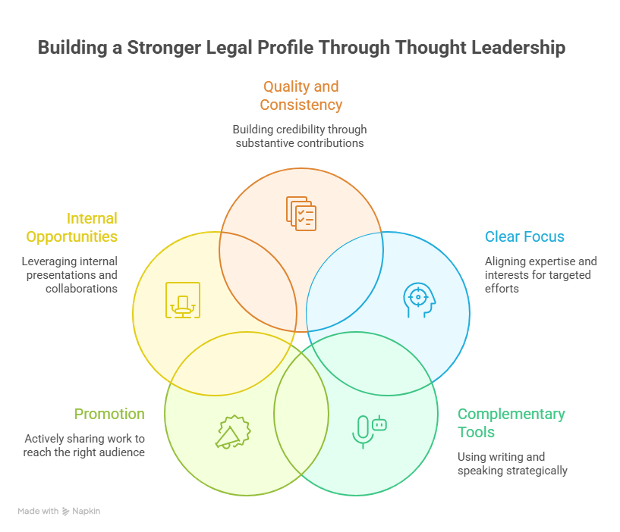
Naomi highlighted that thought leadership, when approached strategically, is a powerful tool for building a lawyer’s profile both internally and in the market.
- A clear focus is essential: Aligning your expertise, experience, and interests ensures your efforts are targeted and sustainable.
- Writing and speaking are complementary tools and should be used strategically, with content repurposed where possible to maximise impact.
- Promotion is as important as content: Actively sharing your work ensures it reaches the right audience.
- Internal opportunities, including presentations and collaboration, can serve as effective stepping stones to external visibility.
- Quality and consistency matter more than quantity: Well-prepared, substantive contributions build a stronger and more credible reputation over time.
Audience Engagement and Q&A Highlights
The Q&A session addressed practical concerns:
- Getting started early in your career: Even without extensive experience, lawyers can begin by identifying areas of interest and following industry developments. Monitoring news and client issues can generate ideas for initial content.
- Balancing exploration and specialisation: Exploring different areas early on is valuable, but should be time-bound. Developing a clear direction is essential for long-term progress.
- Publishing as a newcomer: Short-form publications and blogs are often more accessible than academic journals. Building relationships with editors and leveraging firm networks can facilitate publication opportunities.
- Use of social media: LinkedIn remains a key platform for professional visibility. While other platforms may be relevant in certain markets, a strategic and professional approach is essential.
Conclusion
Naomi concluded by encouraging lawyers to approach thought leadership as a strategic and ongoing process. By identifying a clear focus, producing high-quality content, and actively promoting their work, lawyers can build a strong professional presence in both the market and their firm.
Through consistent effort, thoughtful positioning, and effective use of writing and speaking opportunities, thought leadership becomes a powerful tool for career development and long-term success.
The episode recording is available on the Lawyering Plus YouTube channel.
Follow Lawyering Plus on LinkedIn and Arbi.City to receive updates on future episodes and learn more about soft skills. Feel free to subscribe here to be notified about the next episode.
ABOUT THE AUTHORS
Naomi Briercliffe is a Partner and Solicitor Advocate in the International Dispute Resolution practice at Squire Patton Boggs in London. She is ranked by Chambers UK & Global and Legal 500 UK for international arbitration and public international law, and is recommended in the Lexology Arbitration Index. Naomi represents states, corporates, and high-net-worth individuals in commercial and treaty arbitrations and before international courts and tribunals, with experience across sectors including energy, mining, infrastructure, aviation, TMT, and private equity. In addition to her counsel work, she advises on dispute avoidance, risk mitigation, and enforcement, sits as an arbitrator, and serves on the Users’ Council and EDI Steering Group of the LCIA. She is also an Honorary Fellow of BIICL and sits on the peer review board of the ICSID Review
Svetlana Portman is an associate in the London office of Debevoise & Plimpton and a member of the International Dispute Resolution Group. Her practice focuses on international arbitration and public international law. Svetlana represents private clients and states across multiple jurisdictions in investor-state and international commercial arbitrations governed by various substantive laws and conducted under the auspices of the major arbitral rules, including ICSID, LCIA, ICC and UNCITRAL. She is familiar with disputes across a broad range of industries and sectors. Svetlana is admitted as a Solicitor of the Senior Courts of England & Wales and to the bars of New York State and Israel. As a solicitor-advocate, Ms. Portman has full rights of audience before all civil courts of England & Wales. She is one of the founders of Lawyering Plus.

*The views and opinions expressed by authors are theirs and do not necessarily reflect those of their organizations, employers, or Daily Jus, Jus Mundi, or Jus Connect.