
Lawyering Plus Webinar: S2 EP2
THE AUTHORS:
Charlie Caher, Partner at WilmerHale
Dr Ilka Beimel, Senior Associate at Noerr
“The lifeblood for any law firm – regardless of its size and composition – are its clients. And acquiring and retaining clients is the single most important skill for any lawyer that hopes to have a long and successful career.”
Charlie Caher
About Lawyering Plus
Lawyering Plus is an initiative set up by Mihaela Apostol, Dr Ilka Beimel, and Svetlana Portman to help lawyers build soft skills. Lawyering Plus organizes webinars and invites expert speakers to share tips on a particular soft skill. Each episode ends with an interactive Q&A segment. The first season focused on communication skills, followed by season two on business development and branding.
Second Episode: Business Development & Pitching with Clients
On 30 July 2025, Lawyering Plus hosted Charlie Caher, who is a partner in WilmerHale‘s Litigation/Controversy Department, and a member of the International Arbitration Practice Group. Charlie delivered a practical webinar on business development and pitching with clients, drawing on years of high‑stakes arbitration work across energy, construction, insurance, financial services, telecommunications and aerospace. His message: acquiring and retaining clients is a core professional skill that young lawyers rarely learn formally, yet it is essential for long‑term success.
How to Effectively Acquire Clients?
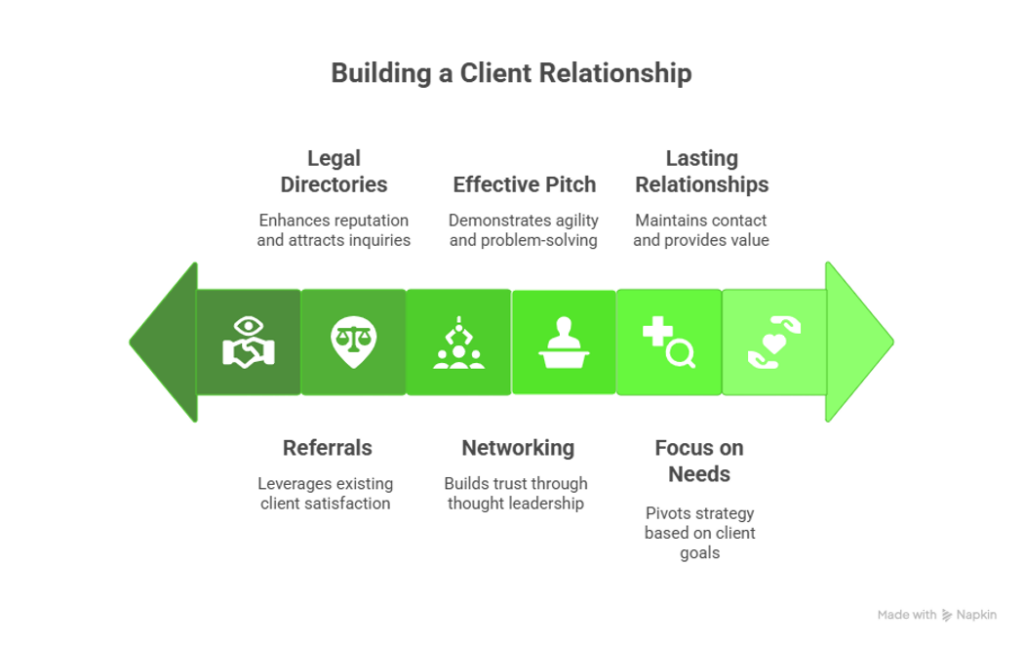
Charlie commenced by identifying several complementary channels for effectively acquiring clients:
- Referrals: The most powerful source. Deliver excellent work for existing clients. Satisfied clients and impressed opposing counsel often recommend you later. Internal cross‑selling across practice areas and office locations is also key – treat every instruction as an opportunity to enhance your and your firm’s reputation.
- Legal directories and rankings: Be aware that listings in guides such as Chambers, Legal 500 or GAR provide a credibility watermark that helps attract inquiries and strengthens pitches.
- Networking and thought leadership: Regular contribution of articles, blogs, conference speaking, and sector engagement builds visibility and trust over time.
Above all, Charlie advised to be proactive. This includes, for example, monitoring general and sector news and following clients’ corporate developments. Additionally, it might be useful to cultivate relationships with other law firms that can co‑counsel when complementary strengths are required.
How to Identify Opportunities for Pitches?
Opportunities often appear around real‑time business events: expropriations, environmental incidents, bankruptcies, supply‑chain shocks, commodity price spikes, or regulatory changes. Thus, Charlie recommended first, watching mainstream and industry media for events that create legal needs; second, tracking client‑specific signals (M&A activity, commodity price movements in energy sectors) that may drive disputes, and third, building referral networks so you are top‑of‑mind when a pitch opportunity arises.
Furthermore, prompt outreach – in particular when an issue is timely – can make your contact the right call at the right moment.
How to Deliver an Effective Pitch?
Charlie reminded the audience that preparation is everything. Thus, he advised researching the client, the project and industry dynamics in advance to ensure that the legal advice is grounded in commercial reality. Likewise, it is important to know your audience: are you speaking with in‑house counsel who understand arbitration, or C‑suite non‑lawyers who need a different level of explanation?
When delivering the pitch, avoid spending pitch time reciting credentials. Send a credentials deck for background reading and use live time to demonstrate the substantive value you bring. For example, use concrete case studies and “war stories” that show prior success and practical problem‑solving.
Finally, treat the pitch as a conversation rather than a presentation. That permits real‑time engagement and demonstrates agility.
How to Prepare for Pitches and Client Meetings?
Diving deeper into the importance of preparation and the goal of a natural, unscripted conversation, Charlie provided the following concrete advice:
- Homework: Do diligent homework on the client’s business, stakeholders and the likely audience level of legal sophistication.
- Be concrete: Prepare examples, likely questions and tailored strategy options, but avoid rote scripts.
- Mentorship: Seek mentorship and sit in on pitches as a junior to learn techniques (and mistakes to avoid).
- Everyday training: Treat everyday persuasive opportunities – internal requests, small negotiations, even informal team decisions – as practice for pitch skills.
How to Focus on Client and Business Needs During a Pitch?
Turning to the pitch itself and the difficult question of how to focus on the client and business needs during the pitch, Charlie highlighted one key aspect: listen first. Ask what outcome the client truly wants. Charlie emphasised that clients’ objectives are not always to “win” at all costs – early settlement or commercial solutions may be preferred. Be ready to pivot strategy in response to client goals.
Other considerations when focusing on client and business needs during the pitch are, first, demonstrating the ability to problem‑solve in the moment – that distinguishes you from equally technically capable competitors – and second, to address fee sensitivity proactively. Provide cost frameworks and options so in‑house teams can present realistic budgets internally.
How to Build Lasting and Personal Relationships with Clients?
Finally, sustaining engagement after a matter concludes is critical – clients may not need you often, but when they do, you want to be their first call. Charlie’s practical suggestions to achieve this goal are:
- Build personal rapport: learn about families, hobbies and interests; use personal touchpoints (congratulatory notes, event invitations) to maintain contact.
- Stay informed about the client’s business and industry so you can proactively flag risks or opportunities.
- Provide gratuitous value: share relevant articles, judgments or short briefings that matter to the client.
- Use follow‑up opportunities (in‑house presentations, retreats) to deepen relationships; Charlie gave examples where maintaining contact after a dispute led to significant mandates later.
Key Learnings:
- Treat business development as a strategic, proactive skill – know and communicate your firm’s unique selling point.
- Prepare thoroughly but avoid depending on scripts; the best pitches are conversational and client‑centred.
- Listen first: identify the client’s real commercial objective (litigation, settlement, strategic workaround).
- Demonstrate practical problem‑solving and cost awareness in real time.
- Build personal as well as commercial relationships and stay engaged after matters close – small, thoughtful touches pay long‑term dividends.
Charlie’s advice stresses that winning work is as much about mindset and relationships as technical excellence: be proactive, prepare to add commercial value, listen carefully, and cultivate enduring client connections.
Q&A — Practical Takeaways from Audience Questions
The Q&A reinforced strategic choices and practical behaviour for early‑career practitioners. Key practical points were:
- Specialise deliberately to spot niches: monitor enforcement trends, regulatory shifts and technological change; a focused sector specialism (e.g., oil & gas, construction, sanctions/compliance) can make you stand out and enable targeted outreach such as roadshows and sector briefings.
- Define your USP before you start or grow a practice: decide whether you target a particular industry, price‑sensitive clients, or clients from specific jurisdictions – this focus shapes marketing, networking and service design.
- Handle rejection constructively: if a pitch fails or a client signals disinterest, don’t react defensively. Use the meeting to build rapport, leave the door open for future work and demonstrate professional composure.
- If needed, build experience without a mentor: where formal mentorship is absent, substitute practices include presenting at industry events, offering in‑house briefings, publishing focused commentary, and treating every client contact as a chance to practise pitching and relationship skills.
Conclusion
Winning and retaining client work requires the same discipline applied to legal craft – research, practice and strategic thinking – combined with genuine curiosity about clients’ businesses and priorities. By specialising intentionally, preparing to converse rather than recite, and maintaining relationships after matters close, lawyers can convert episodic engagements into durable client partnerships. Charlie’s practical examples show that persistence, focus and thoughtful outreach produce tangible, long‑term rewards.
Next Episodes
The third session focused on Business Development & Growing Your Profile Within the Law Firm. The recording is available here. Follow Lawyering Plus on LinkedIn and Arbi.City to receive updates on future episodes and learn more about soft skills. Feel free to subscribe here to be notified about the next episode.
ABOUT THE AUTHORS
Charlie Caher is a partner in WilmerHale’s Litigation/Controversy Department, and a member of the International Arbitration Practice Group. Based in the London office, Charlie is a leading practitioner in International Arbitration and English High Court Litigation. With extensive experience representing clients in both institutional and ad hoc arbitrations under all major arbitral institutions, Charlie’s practice spans major civil and common law jurisdictions – including London, Paris, Stockholm, Singapore, The Hague, Bermuda, and Brunei. Charlie’s international commercial and investment arbitration practice covers a wide range of industries, with a particular focus on energy, construction, insurance, financial services, telecommunications and aerospace.
Beyond his impressive client work, Charlie has served as an adjunct professor at Pepperdine Law School’s London campus, teaching International Commercial Arbitration. He is also actively involved in the arbitration community as a member of the ICC Arbitration and ADR Committee (UK), the Chartered Institute of Arbitrators (CIArb), and as an executive member of Arbitration Ireland’s London Chapter.
Dr Ilka Beimel is a senior associate in Noerr’s dispute resolution team, based in Dusseldorf. She specialises in national and international dispute resolution before arbitral tribunals and state courts. Ilka advises and represents clients on complex cross-border disputes, especially corporate, liability and commercial disputes. She has particular experience in handling disputes involving international sales law. Ilka works as party representative, arbitrator and tribunal secretary. In these roles she gained experience in arbitration proceedings governed by DIS, CAM-CCBC, ICC, LCIA and VIAC Rules, as well as ad hoc proceedings.

*The views and opinions expressed by authors are theirs and do not necessarily reflect those of their organizations, employers, or Daily Jus, Jus Mundi, or Jus Connect.